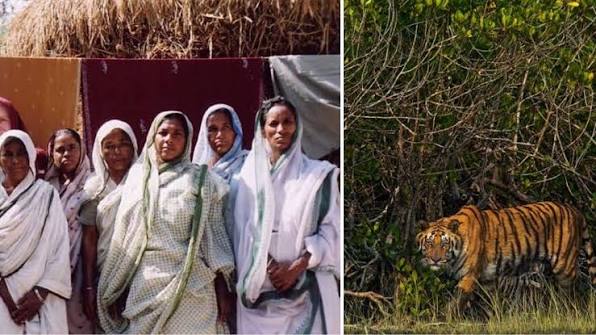
Where the muddy waters of the Hooghly-Matla estuary blur into the emerald canopy of the world's largest mangrove forest, human existence is measured in sheer resilience. Here, in the remote deltaic terrain of South 24 Parganas, life moves to the rhythm of the Bay of Bengal's merciless tides and the silent shadow of the Royal Bengal Tiger. For generations, the communities on islands like Gosaba, Pakhiralay, and Satjelia have walked a razor's edge. This is the paradox of the Sundarbans—a UNESCO World Heritage site of breathtaking wild beauty, and a theater of unrelenting human hardship.
Life on the Edge: The Danger of Honey Collecting in the Sundarbans
As spring arrives, groups of local men known as mawalis venture deep into the forbidden core zones of the tiger reserve. Their mission is to harvest wild floral honey from Khalisa and Garan blossoms—an essential economic lifeline for families priced out of subsistence farming. Armed with little more than a wooden paddle, an earthen smoke pot called a dhup, and deep faith in forest deities like Bonbibi and Shah Jongli, these collectors navigate labyrinthine creeks where danger waits behind every root. The forest does not forgive a careless step. A moment's distraction can bring a fatal ambush by the apex predator, turning a routine trip into a funeral.
The Untold Stories of the Tiger Widows of South 24 Parganas
When a mawali or a crab-collector vanishes into the deep jungle and never returns, a heavy silence settles over villages like Dayapur and Lahiripur. The women they leave behind swell the ranks of the Sundarbans tiger widows. Branded as 'unlucky' by harsh social superstitions and largely ignored by institutional safety nets, they face profound isolation. Many cannot even claim legal widow pensions because their husbands were technically classified as trespassers inside government-protected zones. Yet, surviving on plain rice and salt while enduring grueling hours of labor to weave nets or clear silt, their quiet strength refuses to break.
The mangrove does not merely hide our dead; it demands our labor, our fear, and our quiet endurance day after relentless day. — Padma Naskar, resident of Satjelia island
Economic Struggles and Resilience in the Mangrove Frontier
The micro-economy of the lower delta relies on the informal trade of forest produce and fragile seasonal paddy crops, both battered by a changing climate. Cyclonic storms like Amphan and Yaas have repeatedly flooded freshwater ponds with brine, destroying local livelihoods and driving desperate migration. But grassroots collectives and women-led self-help groups are pushing back. By refining local honey, embracing organic crab-farming, and building community-led eco-tourism, they are trying to script a different future. The story of the tiger widows and honey collectors is not just a tragedy; it is the living pulse of Bengal's southernmost frontier.