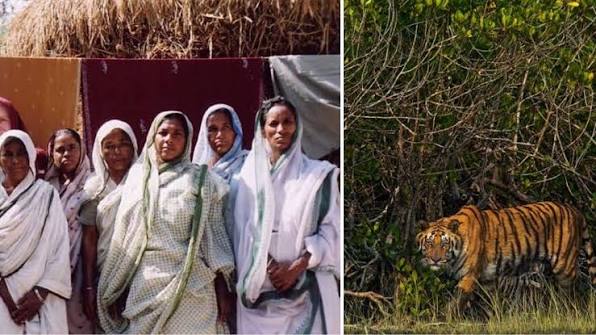
When the saline breeze turns warm over the Matla River in early spring, the rhythm of life changes across the riverine hamlets of South 24 Parganas. This is the season when the moulis—traditional honey collectors of the Sundarbans—prepare their narrow wooden boats for the dense mangrove interiors. For centuries, these men have ventured into the tidal maze to harvest wild honey from the hives of Apis dorsata, suspended high in the branches of khalsi and gewa trees. Yet every season, this journey into the forest primeval carries an unwritten pact with mortality. In villages like Dayapur, Jharkhali, and Lahiripur, thousands of women known locally as Bagh Bidhoba (tiger widows) bear the living quietude of that cost, navigating life after their husbands fell prey to the Royal Bengal tiger.
Historical Roots and Context
The relationship between the coastal inhabitants of South 24 Parganas and the deltaic forest is governed by an ancient ecological philosophy. Long before modern conservation boundaries split the delta into core zones and buffer spaces, the forest was viewed as the domain of Ma Bonbibi, the guardian deity of the mangroves, and her mythic adversary Dakshin Rai, the lord of tigers. Forest workers—whether collecting honey, cutting timber, or casting nets for shrimp fry—have historically relied on syncretic rituals that transcend formal religious lines. Before entering a khari (narrow tidal creek), a mouli troupe performs rituals invoking Bonbibi's protection, binding themselves to a strict moral code: take only what is needed, leave no trash, and harm no living creature unnecessarily.
Economic marginalization in the southernmost blocks of the district—such as Gosaba, Basanti, and Patharpratima—has historically forced villagers to take immense risks. As agricultural land degenerates due to frequent cyclones like Aila and Amphan and rising soil salinity, dependence on forest produce deepens. Though the West Bengal Forest Department issues seasonal permits for honey collection, many collectors are driven into restricted core areas where human presence is forbidden and tiger density is highest. When a collector is killed deep inside the reserve, the death often goes unreported to avoid legal penalties, leaving the surviving widow stripped of both economic support and government compensation.
"The forest does not ask for your faith; it demands your obedience to its boundaries. When the tide turns and the mud softens, you learn that every drop of honey carries the weight of a life."
Key Highlights and Local Experience
The harvest of Padma Madhu (the prized golden honey harvested from khalsi flowers) is an intense, communal endeavor. A typical mouli expedition consists of five to seven men operating in treacherous conditions. They maneuver their rowboats through waist-deep mudflats riddled with breathing roots (pneumatophores), exposed to saltwater crocodiles below and camouflaged predators on land. To ward off strikes from behind, collectors traditionally wear clay masks facing backward or rely on smoke bundles called huli, ignited from wet leaves to douse the aggressive wild bees.
Yet, the true core of resilience in South 24 Parganas today resides in the women left behind. In recent years, the tiger widows of Jharkhali and Bali Island have shifted the narrative from passive grief to collective self-reliance. Autonomous self-help groups, supported by regional civil society organizations and local panchayats, have developed alternative livelihoods designed to keep families out of the apex predator’s territory. Women-run cooperatives now manage organic mud-crab farming, backyard poultry, tailored handicrafts, and native mangrove nurseries.
Cultural expressions have also evolved. Through traditional Bonbibir Pala (folk theatre performances), local troupes communicate essential lessons about biodiversity, climate change, and forest safety. These performances preserve the linguistic cadences of coastal Bengal while serving as a living archive of deltaic struggle.
How to Visit or Learn More
For visitors interested in understanding the ecological and human landscape of the Sundarbans beyond standard tourist itineraries, responsible travel is essential. The entry point to this amphibious world begins at Canning, the gateway railway station in South 24 Parganas, followed by a road journey to Godkhali boat jetty.
- Support Community Initiatives: Prioritize eco-lodges and tour operators managed directly by local islanders on Bali Island or Dayapur. These establishments employ local youth and channel a portion of their earnings into health clinics for forest-dependent families.
- Purchase Ethical Delta Produce: Look for wild honey certified by local cooperatives such as the West Bengal Forest Development Corporation (WBFDC) or small-scale community trusts that buy directly from verified mouli collectives at fair wages.
- Respect Local Norms: When visiting villages in the lower delta, engage with community members through organized cultural exchanges rather than invasive photography. Understanding the delicate balance of the mangrove ecosystem requires listening to the stories of those who inhabit its margins every day.