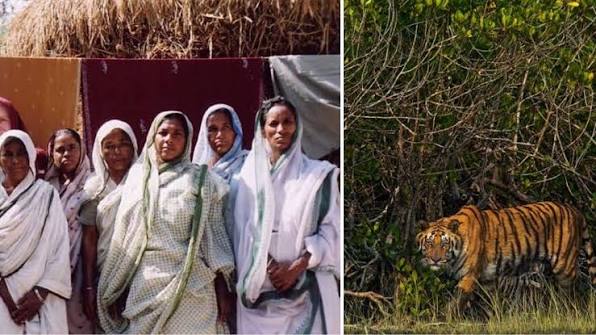
The morning mist over the Matla river doesn't just settle; it hangs heavy with a quiet dread that shapes every hour at the edge of the world's largest mangrove delta. Here, deep in South 24 Parganas, where the deep green canopy of the Sundarbans meets the biting, salty tides of the Bay of Bengal, life is lived on impossibly narrow margins. For generations, people in islands like Gosaba, Hingalganj, and Patharpratima have lived alongside apex predators and wild weather, carrying a mix of deep devotion and raw trauma for the forest they know as Banbibi's domain.
Life on the Edge: The Mangrove Frontier of South 24 Parganas
Geography here is fragile and quick to change. The mainland breaks apart into a maze of muddy creeks, twisting rivers, and thick mangroves where the tides constantly steal and rebuild the mudbanks. Families scrape by on mud embankments that regularly give way when cyclones like Amphan and Yaas tear through, sweeping away homes and ruining freshwater ponds with salt. In villages like Dayapur and Pakhiralaya, daily life means crossing waters where the shadow of the Royal Bengal Tiger is never far off. There are no highways linking these remote riverbanks to the city; instead, noisy motorboats and wooden country boats act as the lifelines, carrying people, bicycles, and sacks of fresh paddy.
The Tragic Reality of Sundarbans Tiger Widows
Behind the glossy travel brochures of wildlife safaris lies a brutal human cost. The women known as Sundarbans tiger widows—or bidhaba—carry one of the heaviest burdens in rural Bengal. When a breadwinner sneaks into the core forest under permit or quietly on his own to fish, crab, or collect honey, and a tiger takes him, his family is instantly pushed into poverty and pushed out by society. Widows from places like Satjelia are often blamed by superstitious elders, branded as unlucky bringers of bad luck for their husbands' deaths. On top of the grief, the legal fights are exhausting; because entering reserve forests is illegal, many deaths go undocumented by the forest department, robbing families of government compensation and leaving them at the mercy of harsh local moneylenders.
The tiger doesn't just kill a man; it strips the family of its social standing and its meager livelihood, leaving behind women who must constantly fight the stigma of being the forest's unlucky prey.
Into the Deep Forest: The Perilous Journey of Honey Collectors
When April and May roll around and the khal banks burst into bloom with wild mangrove flowers, the moule—the traditional honey collectors—get ready for their dangerous yearly trip. Armed with little more than wooden axes, earthen pots, a smoky rag, and absolute faith in the goddess Banbibi, groups of men climb into wooden dinghies to search the thick forest for massive Apis dorsata honeycombs. Before their boots touch the mud, they perform a quiet puja, whispering prayers to calm Dakshin Ray, the lord of the tigers, and the protector Gazi Pir. The journey is a tense, silent test of nerve. Collectors push through knee-deep mud, watch out for saltwater crocodiles, and climb thorny branches away from stinging bees, knowing a single rustle in the leaves could mean a tiger is waiting.
Resilience and Survival in the World's Largest Delta
Yet, people here refuse to give in to despair. Lately, grassroots groups and local collectives have stepped up to help the women of the region find their footing. Tiger widows are slowly building self-help groups, trying their hand at crab fattening, organic farming, and tailoring to earn their own living. As evening settles over the village yards and families sit down to a simple meal of steaming hot bhaat and macher jhol, stories of survival pass down like heirlooms. The fight against climate change, rising seas, and wild animals goes on, but the grit of South 24 Parganas runs as deep and stubborn as the stilt roots of the Sundari trees.